12 Apostles
These are the 12 Apostles in Victoria, Australia. For more information, visit here.

What has the universe got to offer?
These are the 12 Apostles in Victoria, Australia. For more information, visit here.
Humans often wonder if we are the only ones out here. This seems a reasonable thing to ponder considering the numerous number of stars and planets in our galaxy and in the entire universe. Our natural interest in outer civilization similar to that of humankind is part of the reason why topics such as aliens and UFO sightings easily grab the attention of the public. For example, in September 2019, people tried to raid the military base known as Area 51 in hopes of finding secretly kept aliens. Although this event was done as a joke, it clearly shows the public’s interest in extraterrestrial civilization.

In the search for extraterrestrial intelligence (known as SETI), an astronomer named Frank Drake formed an equation to estimate the number of civilizations in the Milky Way Galaxy. The simplified version of this equation is shown below.

N_HP is the number of planets in the galaxy that could potentially have life, f_life is the fraction of these planets that actually contain life, f_civ is the fraction of planets that contain life that have civilizations that were capable of interstellar communication at some point in time, f_now is the fraction of such planets that have a civilization in the present moment
This equation cannot be used to actually calculate tangible numbers, but we can use the fact that most civilizations fade away soon after reaching the intelligence level that allows them to make interstellar communication to reach a reasonable conclusion. This fact implies that f_now is extremely small (very close to zero), and allows us to conclude that we are really the only civilization that is intelligent AND active at the moment.
This conclusion, however, is just based on one simplified equation and not sophisticated enough accommodate for all other factors we know about extraterrestrial life. We may be missing something big because we haven’t reached a certain intelligence level yet, and it would be interesting to see how further advancements in technology affects the search for extraterrestrial intelligence.
If you’ve been scrolling through random news articles over the past few weeks, you may have come across an article about a large asteroid that may end human civilization if it strikes the Earth. Just to be clear, this asteroid will not hit Earth and will barely have any effect on civilization.
NASA is currently tracking this asteroid that is headed our way. The asteroid (52768) 1998 is about 4 km wide, making it the biggest asteroid to pass Earth this year. The asteroid will come closest to Earth on April 29th – it will be about 6 million kilometers away from us, a large enough distance for us to not worry about a potential collision. The asteroid will travel at about 31,320 km/hr and will appear as a slow-moving star to observers here on Earth. Astronomers around the world are already tracking this asteroid – below is an image of the asteroid taken by a robotic telescope called Elena on March 6th.
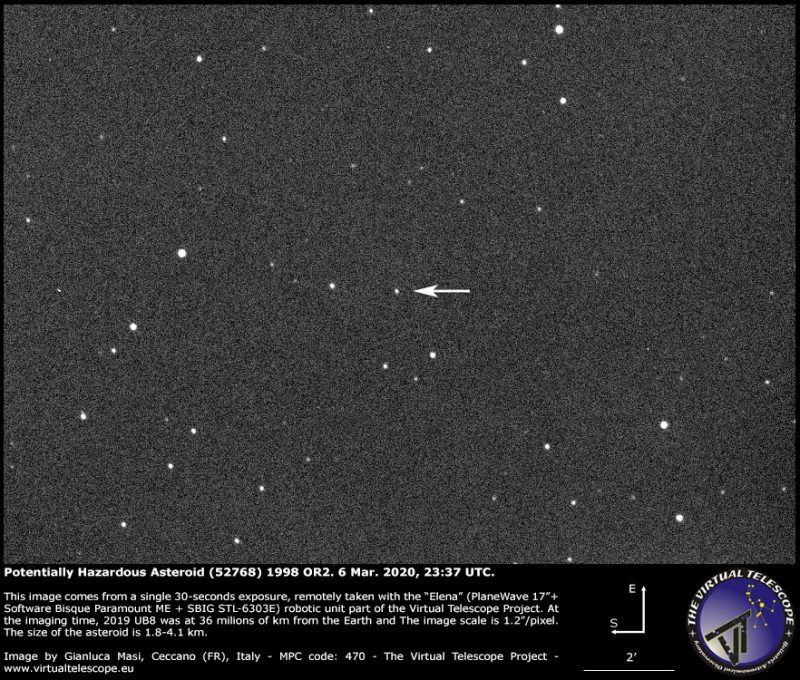
Although this asteroid will have no effect on us, it’s still cool to see a moving object in space. The movement cannot be detected with a naked eye, but the asteroid’s flyby will be streamed online for viewers all over the world on the 29th.
The speed of light, often denoted by the constant “c,” is faster than anything that we know. Although there have been attempts to get certain particles to travel faster than the speed of light, like when scientists at the CERN laboratory in Switzerland tried to get a hold of neutrinos, no one has successfully broken this barrier yet (Metro). Why would humans want something to travel faster than the speed of light in the context of astronomy? Much has to do with space exploration. Being able to travel faster than the speed of light means that spacecrafts can travel more distance in a shorter period of time, allowing us to explore more space with less time.
Is there an alternative way to solve this problem? Well, it’s unlikely that we’ll ever get a physical object to travel faster than light. The famous equation developed by Einstein, E=mc^2, says that mass is basically energy. In order for mass to accelerate and reach higher speeds, we need energy. And for mass to reach the speed of light would require an infinite amount of energy, which is essentially impossible.
So, what now? An interesting alternative involves the warping of space-time. It remains theoretical as of now, but may become reality in the future. Einstein’s theory of general relativity says that the presence of energy warps space-time. If space-time can be warped in such a way that “folds back on itself,” spacecrafts may be able to enter one part of the universe and exit the other, essentially taking a “cosmic shortcut” (Metro). This phenomenon has never been observed in real life and still remains in the science-fiction realm. But if technology ever becomes advanced enough to allow for such things to exist or if we happen to find a natural way to warp space-time in such a way, it would have huge implications on space exploration and lead to many new discoveries.
Source Used: Metro
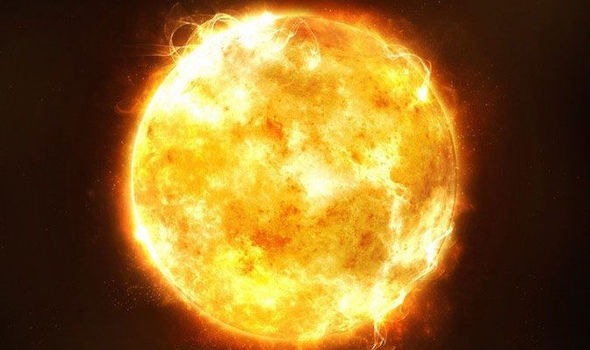
From what we know about planets like the Earth and its properties, we may expect the Sun to also experience a bulge, causing its shape to deviate from a perfect sphere. It turns out that the Sun isn’t a perfect sphere, but it’s pretty close to one. If fact, with the help of instruments on Nasa’s Solar Dynamics Observatory, scientists have identified the Sun as the most perfect sphere in nature.
Let’s dive a little deeper into this matter. Because the Sun spins on its axis, we would expect centrifugal force to cause its equator to bulge slightly. It turns out that there is a bulge, but it is almost negligible compared to those that other planets experience. When “scaled to the size of a beach ball, say scientists, the sun’s equatorial bulge would be less than the width of a human hair” (The Guardian). Although the exact reasons as to why the Sun experiences a very small equatorial bulge have not been confirmed, there are a few possible explanations for this phenomenon.
One possible explanation is the Sun’s complicated magnetic field. The magnetic fields inside the Sun could be the force that holds the Sun together, keeping it from bulging out as much as other planets do. Another explanation is the fact that the Sun is a ball of gas, meaning that different parts of the Sun rotate at different speeds, which could also have an effect on the Sun’s shape (Discover Magazine). These explanations have not been confirmed yet to have a cause-and-effect relationship with the Sun’s shape, but it would be cool to see scientists run tests and simulations in the future to figure out what causes the Sun to be so spherical.
Sources used: The Guardian, Discover Magazine
Have you ever been fishing? If you have, you probably know that your success partially depends on whether the ocean experiences a low tide or a high tide. But do you know the science behind what causes tides? Below is a quick and simple explanation why.
Tides are caused by differential gravity. We know from Newton’s universal law of gravitation that any two objects with mass exert an attractive force on each other. This holds true for large masses too, like the Earth and the Moon. The Moon exerts a gravitational force on Earth, but the magnitude of this force differs for different parts of the Earth. The side of the Earth closer to the Moon experiences more force than the side that’s farther from the Moon, which causes differential gravity. Certain sides of the Earth, in response, bulge out, which causes high tides.
The universe is much, much, much bigger than you may think it is. I personally find it inconceivable – my finite brain does not register infinity. The observable universe, as we know it today, is 14 billion years old – this means that we can see 14 billion light-years into the universe. Within this universe are billions of galaxies, each containing billions of stars. The Earth, and our Solar System, is nothing but a microscopic dot within the universe. Here are some mind-blowing facts about the universe that may help you put its vastness into perspective.
As I contemplated about the universe, a couple thoughts came to my mind. Maybe the readers of this post can ponder them too.
We may never know the answers to these questions for certain, but they’re worth thinking about for sure.
Have a WordPress.com account? Log in now.

